 By
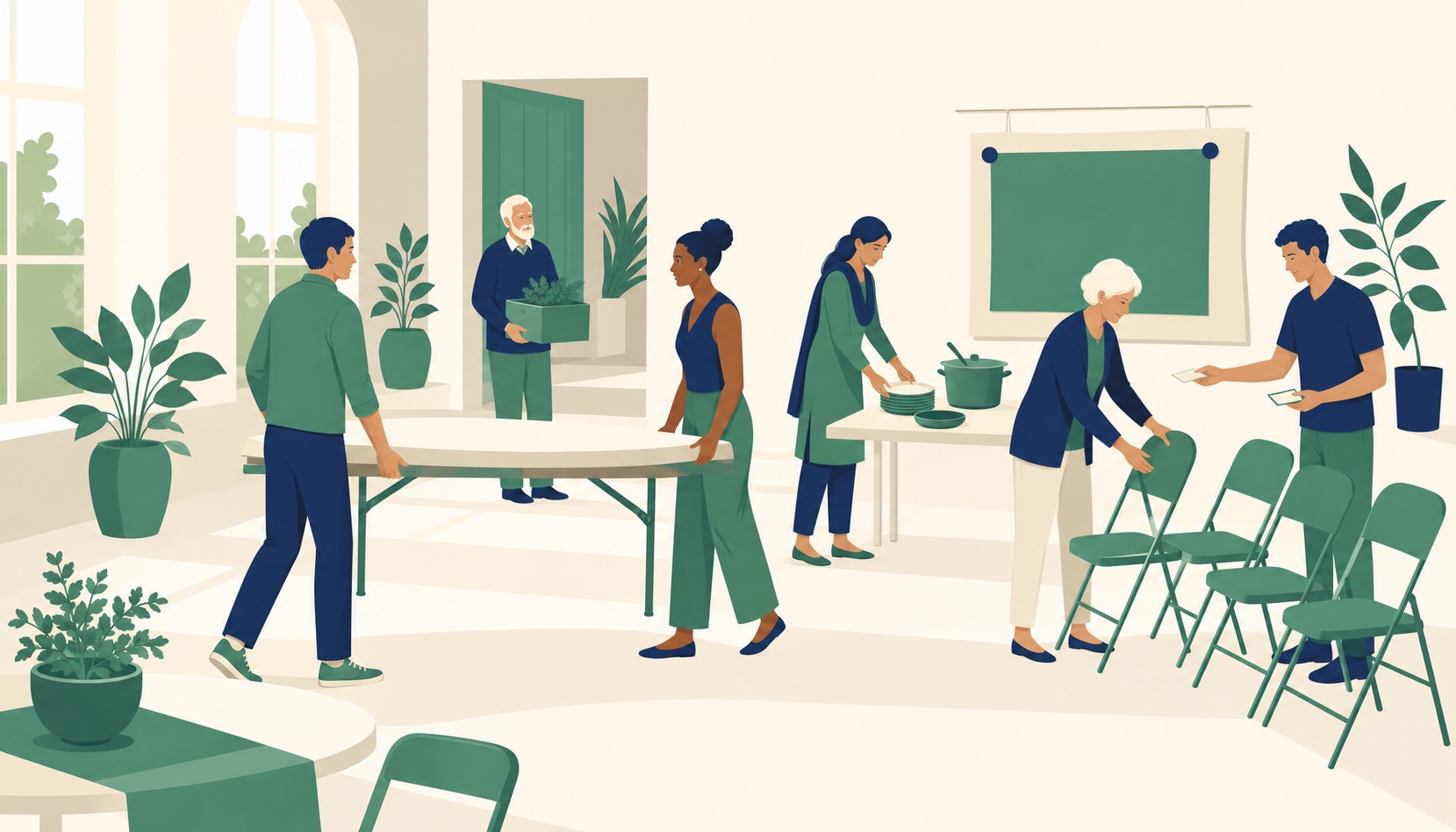
You find community by becoming expected in one group, not by sampling many. Pick a group that meets weekly with the same people, go for eight weeks, and by week three take one small recurring job, such as setting out chairs or running the sign-in sheet. The best-known definition of "sense of community" includes feeling that you matter to the group, and a national survey of U.S. adults found that close friends inside a congregation went with higher life satisfaction more than attendance alone did. Our test for whether you've found it: could you name three people who would notice if you stopped coming?
This page is about in-person community for adults, the kind you can see every week. It isn't clinical advice. If you searched "community groups near me," we can't list your local groups. That search mostly returns event directories such as Meetup, Eventbrite and AllEvents pages, which are useful for finding candidates. The where to look section says what to do with them.
What the top results say
We looked at the top results for "how to find community" on Nov 16, 2026: a personal-growth blog post, a Reddit thread, a magazine article, two Facebook community-page posts, a LinkedIn post, a Medium guide, a Mental Health America page and a lifestyle blog, plus Google's AI summary and its People Also Ask box. We read two of them in full (Caring Magazine and Mental Health America) and judged the others from their search snippets, so treat this as a partial read.
The advice clusters into four moves. Keep showing up at the same places (Caring Magazine says to become a regular at a coffee shop, and one snippet says to pick a group and stick with it). Get into a group built around an interest or a cause, including volunteering. Try a faith community. Use Facebook groups and apps, and check that an online community fits your values (Mental Health America's advice). We agree with most of it. In what we read, we didn't see a way to tell, after you've shown up for a while, whether a group has actually become your community. We also didn't see anyone suggest taking a role. Those two gaps are what this page is about.
Our view: community is a group where you are expected
Our view, which is interpretation with no study behind it: people search for community as if it were a place to locate. We think it works more like a standing expectation. A group becomes your community when three things are true: the same people are there each time, they know your name, and your absence would leave a gap. Most advice covers the first two. The third is the one we rarely see, and the cheapest way to create it is a small job.
Here's a composite. Two newcomers start going to the same Thursday volunteer evening. One comes as a guest each week, enjoys it and chats with whoever is nearby. The other offers to run the sign-in sheet in week three. By week eight, the second person is greeted by name at the door, has a reason to arrive early and gets a text when they're absent. The first person had equally pleasant evenings, but the group never needed them, so nothing was holding the place open.
What the research shows, and what it doesn't
No study we found tests our idea directly. Three lines of research fit it, and each has limits.
One research tradition defines community around mattering. McMillan and Chavis (1986) defined sense of community as a feeling of belonging, a feeling that members matter to one another and to the group, and a shared faith that members' needs will be met through their commitment to be together. They named four elements: membership, influence, integration and fulfillment of needs, and shared emotional connection. Influence runs both ways, covering a member's sense of mattering and the group's effect on the member. That fits our small-job step, since a job is a cheap way to matter to a group. We read a review chapter that quotes the paper and did not read the 1986 article itself. It's a theory paper and tests nothing.
In one national survey, friends inside a congregation went with higher life satisfaction. Chaeyoon Lim and Robert Putnam analyzed the Faith Matters panel, a representative sample of U.S. adults surveyed in 2006 and 2007. According to the study's news release, among weekly attenders with 3 to 5 close friends in their congregation, 33% said they were extremely satisfied with life (a 10 on a 10-point scale). Among weekly attenders with no close friends there, 19% said so, the same as the 19% of people who never attend. People who attended only several times a year but had 3 to 5 close congregation friends came in at 23%. Lim put it this way: making friends in the congregation and building close networks there matters more than attending services and praying (news release; Harvard Kennedy School summary). The limits matter. The data are correlational and from religious settings. The summary says congregational friendships mattered mainly for people with a strong religious identity. The release says the pattern held across Mainline Protestant, Evangelical Protestant and Catholic groups and looked similar for Jews and Mormons on a much smaller sample, with too few Muslims or Buddhists to test. We read the summary and the release and did not read the full paper. The paper reports 3,108 adults in 2006, 1,915 of them reinterviewed in 2007.
Time together has to add up, and not all hours count the same. Jeffrey Hall estimated about 50 hours together to go from acquaintance to casual friend, about 90 to become a friend and more than 200 to become a close friend, using 355 adults who had recently moved and a second sample of 112 first-year students. The University of Kansas release says the time that counts is spent hanging out and joking around, and that hours spent working together count for less (University of Kansas release on Hall, 2018). That is a caution for our own advice. A job gets you expected, but a friendship still needs unstructured time, which is why the steps below include arriving early and staying afterward. We read the release and did not read the full paper.
The settings that supplied those hours have thinned. The Surgeon General's 2023 advisory reports that in-person time with friends fell from 60 minutes a day in 2003 to 20 in 2020 (it adapts the figure from Kannan and Veazie, 2023). It also reports that 47% of Americans said they belonged to a church, synagogue or mosque in 2020, down from 70% in 1999, and it counts volunteer organizations, sports groups, religious groups and member associations as social infrastructure (Surgeon General's advisory). In the Survey Center on American Life's May 2021 poll (2,019 adults, margin of error 2.4 points), 12% reported no close friends, up from 3% in 1990, though the earlier survey was by phone and the later one online. Among people with close friends, 54% had met one through work (theirs or a spouse's), 47% through school, 35% in their neighborhood, 21% at a place of worship and 19% through a club or organization. The shares add to more than 100%, so people met friends in several places (Survey Center on American Life).
Eight weeks: the steps
The numbers here, eight weeks and a job by week three, are our rule of thumb and no study backs them. A two-hour weekly group gives you about 16 hours in eight weeks, well short of Hall's 50, so the goal at week eight is being expected, which comes well before a close friend.
1. Pick a group by its rhythm first
Choose a group that meets on the same day every week, with mostly the same people, small enough that you could learn everyone's name. The topic matters less than that rhythm. A one-off event or a rotating crowd resets the clock each time. Our weekly loops exercise shows how to score the routines you already have for repeat faces.
2. Commit to eight visits before you judge it
The first visit tells you almost nothing about whether this will become a community, and it's usually the most awkward one. Put eight dates in your calendar at the start, so you make the decision at week eight.
3. Arrive ten minutes early and stay ten minutes after
The edges of a meeting are where the unstructured talk happens, and the Hall release says hanging-out time is what counts. Weeks one and two are for nodding, saying one thing about what's happening and learning two names.
4. By week three, take one small recurring job
Pick something small, repeatable and visible: sign-in sheet, setting out chairs, bringing a shared item, starting the group chat, greeting new people. Ask for it in plain words. These scripts are ours and untested.
"I can get here ten minutes early on Thursdays. Want me to take the sign-in sheet?"
"Is there something that needs doing every week that nobody wants? I'll take it for a month."
"I'm new and would like to be useful. Is there a small job I could take on, like greeting or setting up?"
Keep it small enough that you never resent it. A job that grows into a burden turns into the absences you were trying to prevent.
5. Around week six, take one step outside the room
Ask one person for something small: coffee afterward, a walk, a ride. By then you'll have a reason to ask, since you've seen each other six times. This is the unstructured time Hall's release points to.
6. At week eight, run the notice test
Ask yourself three things. Can I name three people here who know my name? Would any of them message me if I missed two weeks? Do I have a reason to be here that isn't only me? If the answer is yes to most, stay. If it's no, choose a different group and repeat the steps. A no tells you about the group's fit. The "three" echoes the 3 to 5 congregation friends in the Lim and Putnam finding, but it's a different measure and our own rule of thumb.
Where to look
The eight-week steps apply to whichever of these you pick.
Faith communities
Congregations are built around weekly gatherings, and the Lim and Putnam finding comes from them. If you share the faith, look beyond the main service to a smaller midweek or home group, because we think that's where names are learned. If you're curious but don't hold the beliefs, say so plainly to whoever greets you, ask what a first visit involves, and don't pretend. Some communities will welcome that and some won't, and either result is fine. Our piece on young adult church groups covers the formats, what a first visit looks like and what to know if you're not religious.
Volunteer shifts
A recurring shift with the same crew, at a food pantry, a trail crew or a library, comes with the job built in. Choose a shift that repeats weekly over a one-day event, and ask the coordinator which tasks are regular.
Clubs, classes and member associations
Community gardens, neighborhood associations, run clubs, sports leagues and hobby groups all qualify if they meet weekly with a stable group. Our adult hobby classes guide covers what a first session is like and which habit decides whether it sticks. If nothing near you meets weekly, you can start something, and how to start a book club that survives month three shows one low-cost way.
Online, as a bridge
Online groups can supply the first names and the first rhythm. Our online communities for lonely people piece offers a three-question test for any online group, and Mental Health America's page on healthy online communities suggests checking that it fits your values and leaves you feeling respected. Treat online as a step toward a room you can enter weekly.
Using a "near me" search well
Directory results are lists of candidates, so scan them for anything that repeats on the same day each week, and cross off one-off events. Then pick one and start the eight weeks. Visiting five groups once each gives you five first impressions and no community.
If it isn't working
If you've done eight weeks and nothing has formed, switch groups before you conclude anything about yourself. If walking in alone is the hard part, bring a friend to the first visit and plan to come back by yourself. If nothing meets near you, start online and keep looking for a standing in-person group. If loneliness feels heavy or constant, a doctor or therapist is a reasonable first call. This page isn't clinical advice.
Where a Circle fits
We build NexSpark Friends around the same idea. A Circle is a small group of four to six compatible people, placed together and meeting on a regular schedule. The same people show up each time and everyone is known by name, which covers two of the three ingredients above. The third is up to you: offer your Circle a small job, like keeping the group chat going or bringing a question to start the conversation. We help you set up a standing meetup, every Circle is ID-verified, and it's free. See why a Circle is four to six people for the reasoning.
We haven't tested whether Circles produce the feeling of being expected, and a Circle is smaller than a congregation or a club, so it won't replace a larger group. Treat it as one option beside the others on this page.
Common questions
What are some ways to get involved in your community?
Pick one recurring thing and show up: a weekly volunteer shift, a faith group's midweek meeting, a neighborhood association, a community garden, a club or a class. The Surgeon General's 2023 advisory counts volunteer organizations, sports groups, religious groups and member associations as social infrastructure. In the Survey Center on American Life's May 2021 poll, among Americans with close friends, 21% met one at a place of worship and 19% through a club or organization. Choose a group that meets weekly with the same people, and ask for one small job by week three.
What is the 11-3-6 rule of friendship?
It's the claim that turning an acquaintance into a friend takes about 11 meetings of about 3 hours each over about 6 months. When we traced it for our 11-3-6 article, the numbers came from a 2022 survey commissioned by a lozenge brand. It isn't peer-reviewed research. The peer-reviewed estimate we rely on is Jeffrey Hall's: about 50 hours together to go from acquaintance to casual friend, about 90 to become a friend and more than 200 to become a close friend (University of Kansas, 2018). Either way, the practical point is the same. You need many repeated hours with the same people.
What do I do if I have no friends?
You are in a larger group than it feels like. In the Survey Center on American Life's May 2021 poll of 2,019 adults, 12% said they had no close friends, up from 3% in a 1990 survey (the 1990 survey was by phone and the 2021 one online, which may affect answers). Start with one weekly group and the eight-week steps above, and expect it to take months. Hall's estimates put a close friendship above 200 hours together. If you feel low or hopeless for weeks at a time, a doctor or therapist is a good person to tell as well.
What is the hardest age to make friends?
No study we found ranks the ages. The Surgeon General's advisory reports that in-person time with friends fell from 60 minutes a day in 2003 to 20 in 2020 for Americans overall, and from roughly 150 to 40 minutes a day for ages 15 to 24. Our hardest-age article points to the late twenties and early thirties as the best-supported answer, and it says plainly that no source measures how hard friendship feels.
How do I find community if I'm not religious?
Congregations are one source, and the research we cite on friendships inside a group came from them. The same ingredients exist elsewhere: a weekly volunteer shift, a club, a class or a neighborhood association, each with the same people and a role you can take. One caution from that study: its summary says congregational friendships mattered mainly for people with a strong religious identity, so don't assume the pattern transfers. If you're curious about a faith group but don't share the faith, say so plainly and ask what a first visit involves.
Sources
- U.S. Surgeon General. Our Epidemic of Loneliness and Isolation: The U.S. Surgeon General's Advisory on the Healing Effects of Social Connection and Community, 2023. Time with friends, 2003 and 2020 (adapted from Kannan and Veazie 2023); membership of a church, synagogue or mosque, 1999 and 2020; definition of social infrastructure. We read the advisory's front sections and not the recommendations text.
- Survey Center on American Life. The State of American Friendship: Change, Challenges, and Loss, June 8, 2021. May 2021 American Perspectives Survey, fielded May 14 to 23, 2021; 2,019 U.S. adults; margin of error 2.4 points. No close friends, 12% (3% in 1990); where people with close friends met them.
- Lim C, Putnam RD. Religion, Social Networks, and Life Satisfaction. American Sociological Review, 2010; 75(6):914 to 933. Read through the Harvard Kennedy School summary and the news release; full paper not read. Faith Matters panel, 2006 and 2007; 3,108 adults in 2006, 1,915 reinterviewed in 2007.
- McMillan DW, Chavis DM. Sense of community: A definition and theory. American Journal of Community Psychology, 1986; 14(1):6 to 23. Read through a review chapter by Rotman and Wu that quotes the definition and the four elements; the original article was not read.
- Hall JA. How many hours does it take to make a friend? Journal of Social and Personal Relationships, 2018. Read through the University of Kansas news release; full paper not read. Study 1: 355 adults who had recently moved; Study 2: 112 first-year students.
- Caring Magazine. How to find a new community, June 20, 2017. Read in full for the summary of what top-ranking advice recommends.
- Mental Health America. How to find healthy online communities. Read in full.
The expected-in-a-group idea, the eight-week steps and the notice test are our own framing. They fit these sources but haven't been tested, and none of the studies measured finding community through taking a role. The research on congregations comes from religious settings. The search-results summary reflects Google results on Nov 16, 2026, which we judged partly from snippets, and other readers may see different results. We used no NexSpark member data. None of this is medical or clinical advice.