How to make friends with social anxiety, without forcing it
 By Kenneth Kintsugi, on friendship · Aug 3, 2026 · Updated Aug 27, 2026 · 8 min read
You want more friends. The wanting is real. But every time you get close to doing something about it, whether that is showing up to an event, texting someone new or joining a group, something pulls you back. It might feel like dread, or a sudden surge of overthinking, or the quiet certainty that it will go awkwardly and not be worth it. That's not a character flaw. That's social anxiety doing what it does, and for a lot of adults, it quietly shapes their entire social life without them fully realizing it.
Why adult friendships feel especially high-stakes with social anxiety
When you were younger, friendships formed largely by accident: shared classrooms, sports teams, neighborhoods. You saw the same people constantly, without choosing to, and closeness built up almost by osmosis. As an adult, none of that is automatic. You have to initiate deliberately, repeat the effort, and navigate the uncertainty of whether the other person actually wants a friendship or is just being polite.
That uncertainty is exactly where social anxiety thrives. Every unanswered text, every conversation that felt slightly off, every event where you didn't quite click with anyone. It all gets cataloged and used as evidence that you're not easy to befriend. The result is a loop: you want connection, but trying feels risky, so you try less, which means fewer chances for things to go well, which makes the anxiety louder.
The environments that make it worse (and why most "social advice" misses this)
Most standard advice for making friends involves exactly the kind of situation that is hardest for people with social anxiety: large gatherings, networking events, group fitness classes where you don't know a soul. These settings have no structure, no shared purpose, and no continuity. Every time, you start from zero.
Unstructured, large, one-off events are the hardest possible environment for someone with social anxiety. They require you to initiate cold, sustain conversation with strangers, and leave without any real foothold for what comes next. Even if one conversation goes well, there's no built-in mechanism to see that person again. You're back to square one at the next event.
This is why people with social anxiety often do just fine with colleagues they see every day, or with a sibling's group of friends they've been absorbed into over years, but struggle enormously to build friendships from scratch in adulthood. It's not about being likeable. It's about the structure, or lack of it.
What actually helps: small, repeated, low-stakes exposure
The research on social anxiety consistently points to one mechanism for reducing it: repeated, low-stakes exposure to the same people over time. Not performing at your best in a high-pressure situation, just showing up again, in a context where the stakes are low and the outcome doesn't define anything.
Every time you interact with the same person and it goes reasonably fine, your nervous system updates its threat assessment downward. Over time, these people stop feeling like strangers and start feeling like yours. The anxiety doesn't necessarily disappear, but it quiets, because familiarity is the antidote to the uncertainty that feeds it.
This is why a small group of four to six people, meeting on a regular schedule, is so much more effective than attending a dozen different one-off events. You're not starting over every time. The friendships have a chance to actually root.
NexSpark Friends places you in a Circle: a group of four to six compatible people near you, who meet in person on a schedule. The same faces, the same table, over time. No cold rooms full of strangers.
Find your CircleHow to make friends with social anxiety, in four steps
Most advice aimed at this skips straight to "put yourself out there," which is the part that isn't the problem. The sequence below is built the other way around, from least exposure to most, and each step only exists to make the next one smaller.
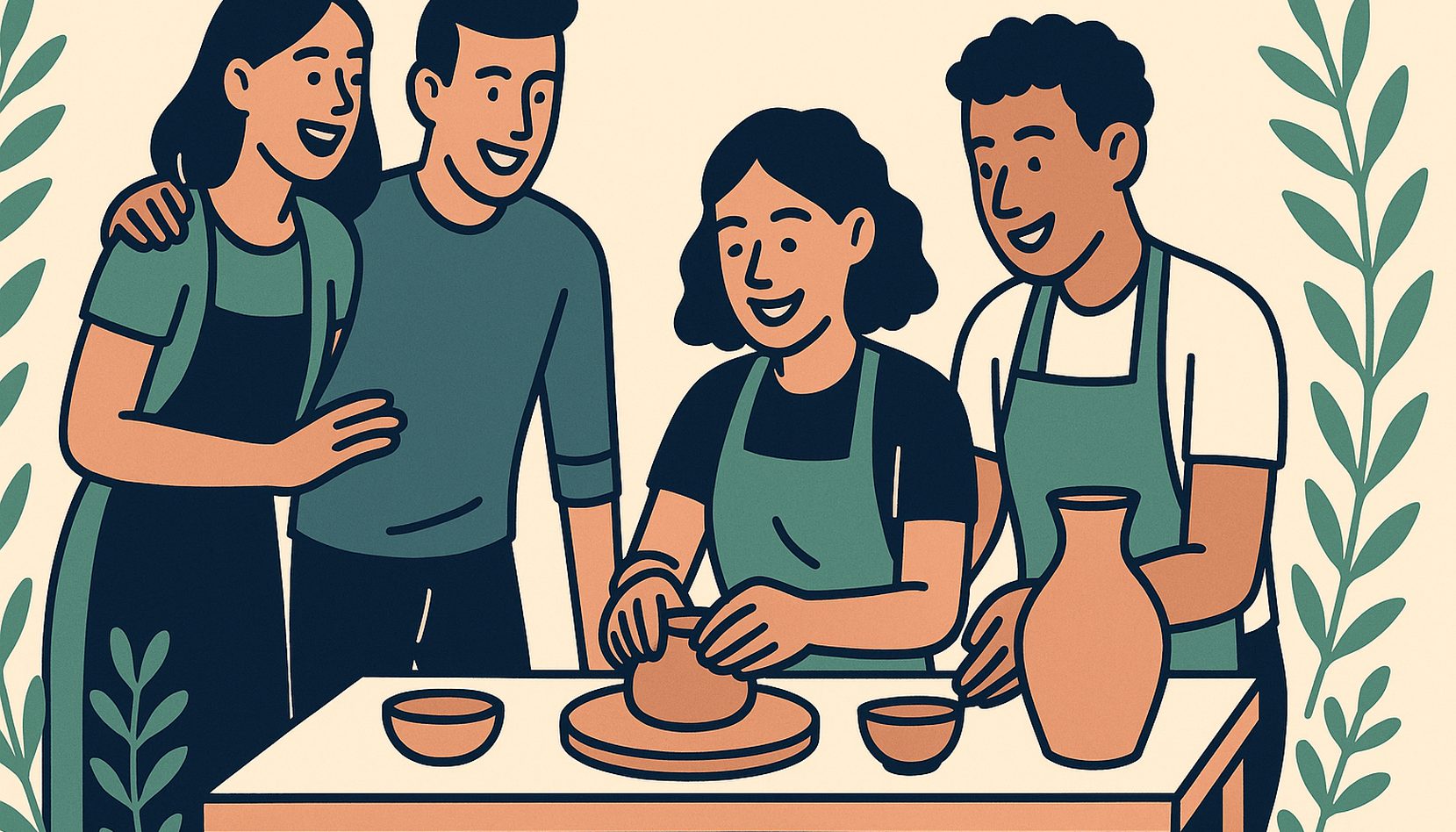
1. Pick a room with a job in it. Not a party, not a mixer, not anywhere the only activity is talking. A pottery class, a volunteer shift, a run club, a board game night, a choir. When there's a task, nobody's watching you, silence isn't a failure, and you already know what you're doing with your hands. A lot of what makes a room hard is simply not having a role in it, and an activity hands you one at the door.
2. Go back to the same one, four times. This is the whole trick and it's the step people skip. A first visit is all threat assessment and no memory. By the fourth, faces have names, someone says hello because they recognize you, and the room has stopped being a room full of strangers. Four ordinary visits will do more for you than four different brave ones, which is the opposite of how this usually gets advised.
3. Make the first move the smallest possible one. Not an invitation. A comment about the thing you're both doing. "How long have you been coming to this?" does more work than any prepared opener, because it's about the shared activity rather than about either of you. The aim isn't to be interesting. It's to be reachable, which is a much lower bar and a far more useful one.
4. Move it sideways before you move it forward. The jump from "person at the class" to "friend" almost never happens through a big ask. It happens through a small adjacent one: walking out together, coffee after, swapping numbers because of something practical. A sideways ask is easier for them to say yes to, and much easier for you to hear a no to.
None of that requires you to be less anxious first. It's arranged so that the anxiety has less to do.
Practical things that ease the pressure
Knowing the mechanism helps, but here are the specific things that make showing up easier in practice:
Choose activity-based contexts. When there's a shared task or focus (a pottery class, cooking together, a walk), there's always something to talk about or look at that isn't each other. The pressure to "perform" socially drops significantly when everyone's hands are busy.
Keep the group small. One-on-one or groups of three to four are almost always easier than larger gatherings. The dynamic is calmer, conversations go deeper, and you're less likely to feel like you're competing for airtime or invisible in the crowd.
Prioritize consistency over novelty. Seeing the same people regularly, even when a given session feels awkward or low-energy, does more for building friendship than attending lots of different events. The friendship isn't in any single meeting; it's in the accumulation of them. Read more about why slow friendship matters more than fast connection.
Lower the bar for what counts as a good interaction. Social anxiety often sets an impossibly high standard for what a successful social encounter looks like. A quiet coffee where you didn't say anything particularly witty still counts. Showing up counts. If you left feeling slightly better than when you arrived, that's a win.
When to get additional support
It's worth naming plainly: if social anxiety is significantly affecting your quality of life and these strategies feel like too big a step, talking to a therapist, particularly one who uses cognitive behavioral therapy (CBT) or acceptance and commitment therapy (ACT), can be genuinely helpful. This article is about the environmental and structural side of friendship-building; it is not a substitute for clinical support when that's what's needed.
Both approaches work best together: getting the internal side supported by a professional, while also making small environmental changes that give your nervous system a fair chance to update. The friendship recession affecting most adults means this is genuinely hard for everyone right now, not just people with social anxiety. You're not behind, and you're not broken.
The longer arc
Making friends with social anxiety is slower than the stories we tell about it. It's not a single brave act. It's a series of small, low-stakes appearances that add up to something real. The people who do it well don't necessarily feel more confident; they've just found environments where the structure does some of the work for them.
If you can get into a small, consistent group with people you're genuinely compatible with, people you'd actually like on a human level, and meet them more than once, you're most of the way there. The anxiety doesn't need to go away first. You just need the right conditions for it to quietly step back. Explore how the science behind small groups explains why four to six people is the size that actually sticks.
Common questions
Why does social anxiety make it so hard to make friends?
Social anxiety creates a painful loop: you want connection, but the fear of being judged, saying the wrong thing, or being rejected makes the first step feel disproportionately risky. Large, unstructured social settings (parties, networking events, bars) are especially hard because there's no natural role or shared task to anchor yourself to. The more effortful each interaction feels, the more you pull back, which only deepens the isolation over time.
What kind of social environment is easier for people with social anxiety?
Small, consistent groups are significantly easier than large, one-off events. When you see the same few people repeatedly, you stop being strangers and start having shared history, which removes much of the uncertainty that feeds anxiety. A structured setting with a clear purpose (a class, a project, a regular meet-up) also helps because it gives everyone a natural focus, so the pressure to "perform" socially is lower from the start.
How do you make friends when you have social anxiety?
Start somewhere that has an activity in it rather than a room where the only thing to do is talk, then go back to that same place several times instead of trying somewhere new each week. Repetition is what turns strangers into familiar faces, and familiarity is what lowers the anxiety. Open with a comment about the shared activity rather than a prepared line, and when you do take it further, take it sideways first: walking out together or coffee afterwards is a much smaller ask than an invitation.
Can social anxiety go away as you make more friends?
For many people, yes, gradually and within safe contexts. Social anxiety tends to ease through repeated, low-stakes exposure to the same people over time. Each interaction that goes well updates your brain's threat assessment downward. This is why recurring contact matters more than sheer quantity of social events. Building a small circle of people you feel genuinely comfortable with can become a foundation that makes wider socializing feel less daunting.
From the same team. If you're also looking for a serious relationship, NexSpark uses the same thoughtful matching approach for dating. No swiping, no algorithm-as-entertainment. Just real introductions.