 By
By 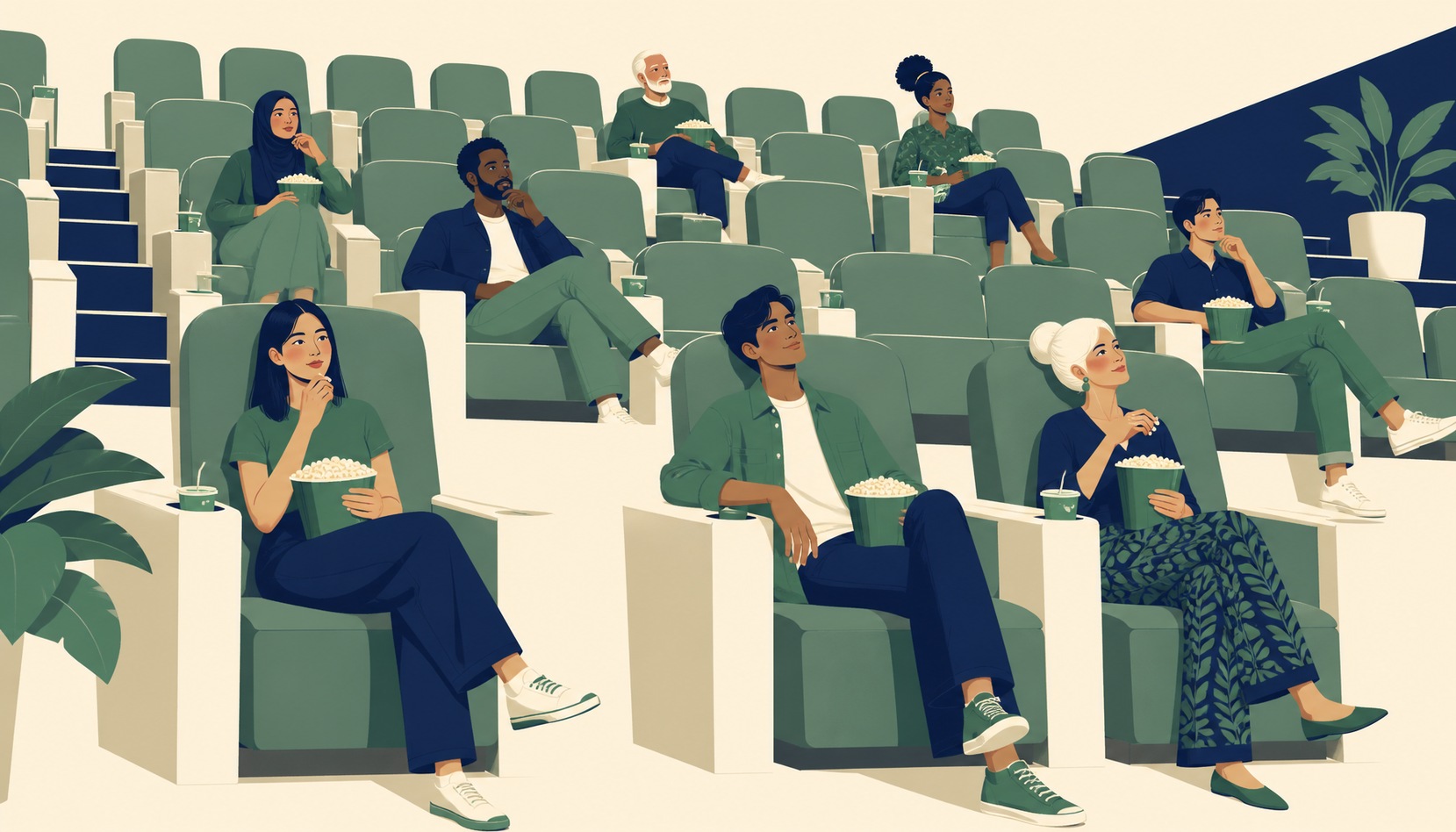
The first time I went to the movies by myself, I bought my ticket at a kiosk specifically to avoid saying "just one" out loud to another person. That was a real thing I did, in my thirties, for a hobby I already loved. Looking back, the kiosk wasn't protecting me from anything. Nobody at that theater was tracking who arrived with company and who arrived without it. I'd invented an audience that never existed, and it cost me years of a genuinely good, genuinely simple pleasure.
Maybe you're circling the idea of going to the movies alone, and something in you keeps stalling out at the ticket counter. This is for you. Not a pep talk about how you don't need anyone, but the actual mechanics: the seat that works, the showtime that works, what to do with your hands before the trailers end, and why the awkwardness you're bracing for is smaller and shorter-lived than it feels from the outside.
Is it actually embarrassing?
Short answer: no, and the room isn't built to notice you either way. Once the lights drop, every seat faces the same direction, toward the same screen, and the person two rows up has no idea and no reason to care whether you came with a date, a group, or nobody at all. The self-consciousness lives entirely in the ten minutes before the movie starts, and it belongs to you, not to the room.
The data backs this up in an oblique but useful way. Fandango's 2026 Moviegoing Trends and Insights Study found that 92 percent of moviegoers say they prefer seeing a film with company. That number gets reported as evidence that moviegoing is inherently social, and mostly it is. Flip it around, though: a real, if uncounted, minority doesn't share that preference, or doesn't mind either way, and that minority is buying tickets at the same box office you are. You are not an anomaly the theater was designed to flag. You're a smaller, quieter, entirely normal slice of the same audience.
The logistics: where to actually sit
Center-back-third, on the aisle. That's the whole formula. The back third keeps the entire screen in your field of view without craning your neck, which matters more solo than in a group, since nobody's going to nudge you to point out you've been squinting sideways for twenty minutes. The aisle seat means you're never wedged between two strangers, which is the one part of solo moviegoing that can genuinely feel cramped rather than peaceful. It also gives you an easy, unembarrassing exit if you need the bathroom, want more popcorn, or the movie just isn't landing for you tonight.
Skip the front row, where the screen fills your whole vision and leaves you with a headache by the third act. On a packed house, skip the literal center too, where you'll spend the film politely negotiating an armrest with someone you've never met. Solo seating is one of the few places where being choosy costs you nothing, since there's no one else's preference to weigh against your own.
What to actually do with your hands (and your phone)
The ten minutes before the trailers start are the only genuinely awkward part, and they're awkward because your hands and your eyes don't have a script yet. Here's a script: check the app for the seat map on the way in, so you're not standing in the aisle scrolling once you get there. Once seated, put your phone away, not because anyone's watching, but because scrolling a bright screen in a dim room for ten minutes is a worse experience than simply sitting there. If you want an occupation, bring a book, or read the trivia slides some chains still run before showtime. Most people, alone or in a group, are doing exactly nothing with the pre-show minutes. You're allowed to do exactly nothing too.
Popcorn etiquette, solo edition: order the size you'll actually finish. A group splits a large without thinking about it; alone, a large becomes a small mountain, either abandoned half-eaten or worked through well past the point of enjoying it. A small or medium, held on your own lap with nobody reaching in from the side, is one of the underrated advantages of going by yourself. You get the whole bag. You also don't have to share it.
Solo trips are one skill, a real friend group is another.
How to build a friend group as an adult →The best time to go, if you have a choice
A weekday matinee or the first showing right after work beats a weekend evening for almost every reason that matters when you're seeing something alone. Theaters run quieter in the early afternoon and again right after the dinner rush clears out, which means more empty seats around you, shorter concession lines, and less chance of ending up next to a group that treats the film as background noise for their own conversation. Weekend prime time is the one slot worth steering around solo, not because anyone will say anything to you, but because a sold-out seven o'clock show is the least restful version of an experience that's supposed to be restful.
Why solo movie-going is quietly becoming a normal thing to do
The same pattern shows up in a completely different room. OpenTable reported that solo dining reservations in the U.S. rose 23 percent in the year through June 2026, with solo diners spending an average of $94 per visit, a 7 percent increase year over year, well above the $60 per-person average across all party sizes. People are getting comfortable taking themselves out to eat, alone, on purpose, spending real money to do it well rather than treating it as a fallback. Solo moviegoing sits right next to that shift: a small, deliberate act of choosing your own company for an evening, rather than settling for it when nobody else happens to be free.
It's also a skill worth having beyond any single evening. Anyone who's spent a holiday without the people they'd usually spend it with, a Thanksgiving alone because travel didn't work out that year, or a birthday that landed on a week nobody else had free, knows the discomfort is mostly about being unpracticed, not about the situation itself. Someone already comfortable buying one movie ticket, sitting through one meal, spending one evening exactly the way they want it, has already done the harder emotional work those bigger, more loaded solo days require. It's the same muscle, exercised on a much lower-stakes night.
That holds true further out too. People who've built a habit of enjoying their own company in small, ordinary ways, a matinee, a solo dinner, a quiet Saturday, tend to describe aging alone with less dread than people who never practiced it. The point isn't learning to be alone forever. It's knowing, from repeated small proof, that your own company is genuinely fine to be in.
Common questions
Is it embarrassing to go to the movies alone?
No, and the room isn't built to notice you either way. The lights go down, everyone faces the same direction, and nobody in a theater is scanning the seats to see who came with whom. Fandango's 2026 Moviegoing Trends and Insights Study found that 92 percent of moviegoers say they prefer seeing a film with company, which leaves a real, if uncounted, minority who don't, or who don't mind either way. You are not the exception the room was built to notice.
What percentage of people go to the movies alone?
There's no single clean number, because most industry surveys ask what people prefer rather than how they actually show up. The closest real data point is that Fandango's 2026 study found 92 percent of moviegoers prefer company at the theater, meaning the remaining share, roughly one in twelve by that measure, are going solo or are fine with it either way. That's consistent with the broader shift toward solo everything: OpenTable reported solo dining reservations up 23 percent year over year in the twelve months through June 2026, so a rising minority is comfortable taking themselves out.
What's the best seat for going to the movies alone?
Center-back-third, on the aisle. The back third of the auditorium keeps the whole screen in your field of view without craning your neck, the aisle seat means you're never squeezed between two strangers, and it gives you the easiest exit for a bathroom break or an early slip-out if the movie isn't landing. Skip the very front row and skip the dead center of a packed house; both put you in the middle of other people's evenings instead of your own.
What's the best time to see a movie by yourself?
A weekday matinee or the first showing after work. Theaters are quietest in the early afternoon and right after the dinner rush ends, which means more empty seats around you, shorter lines, and less chance of getting stuck next to a chatty group. Weekend evenings are the one slot worth avoiding solo, not because anyone will say anything, but because a packed seven o'clock show is the least restful version of the experience.